From Suppression to Restoration: A TCM Case Perspective on 14-Month Recovery in Chronic Eczema 从压制到修复:一例慢性湿疹14个月恢复过程中的中医逻辑
在慢性湿疹或特应性皮炎的治疗中,许多患者都会陷入一种熟悉而无力的循环:发作时靠药物把症状压下去,停药或减药后又再次反弹。久而久之,患者真正困惑的,往往不只是“这次有没有好”,而是“我的皮肤到底是在恢复,还是只是在被暂时控制”。
本案例展示的是一位拥有2年病史的慢性湿疹样皮炎患者。在停止既往免疫抑制性治疗后,于 Tangs Clinical TCM(唐氏中医) 接受了为期14个月的个体化中药调理。随着时间推进,皮损从早期的结痂、红肿、肥厚、粗糙,逐步过渡到后期的平整化、色素残留与皮表质地改善。这个案例最有价值的地方,不在于宣称“快速治愈”,而在于它清楚展示了一个阶段性恢复的轨迹:炎症逐渐退场,慢性增厚慢慢软化,长期受损的皮肤开始进入结构修复。
一、中医如何理解慢性湿疹:为什么单纯压症状,对部分患者并不足够
从现代临床角度看,激素和其他抗炎或免疫抑制治疗在控制湿疹急性发作时,往往是有效且必要的。但对于一部分迁延反复、病程较长的患者来说,仅仅把表面炎症压下去,并不一定等于皮肤本身已获得更深层、更稳定的恢复。
从中医辨证角度看,慢性湿疹并不只是一个表层皮肤问题,而常常涉及 湿、热、毒、营卫失和、血燥、血瘀等多种病机交织。病程一长,皮肤表现出来的就不只是红和痒,还会出现肥厚、粗糙、色暗、苔藓样变等长期重构后的痕迹。
因此,中医治疗的目标,并不只是“把皮疹压下去”,而是要根据病机变化,分阶段纠正导致反复发作和修复乏力的内在失衡。
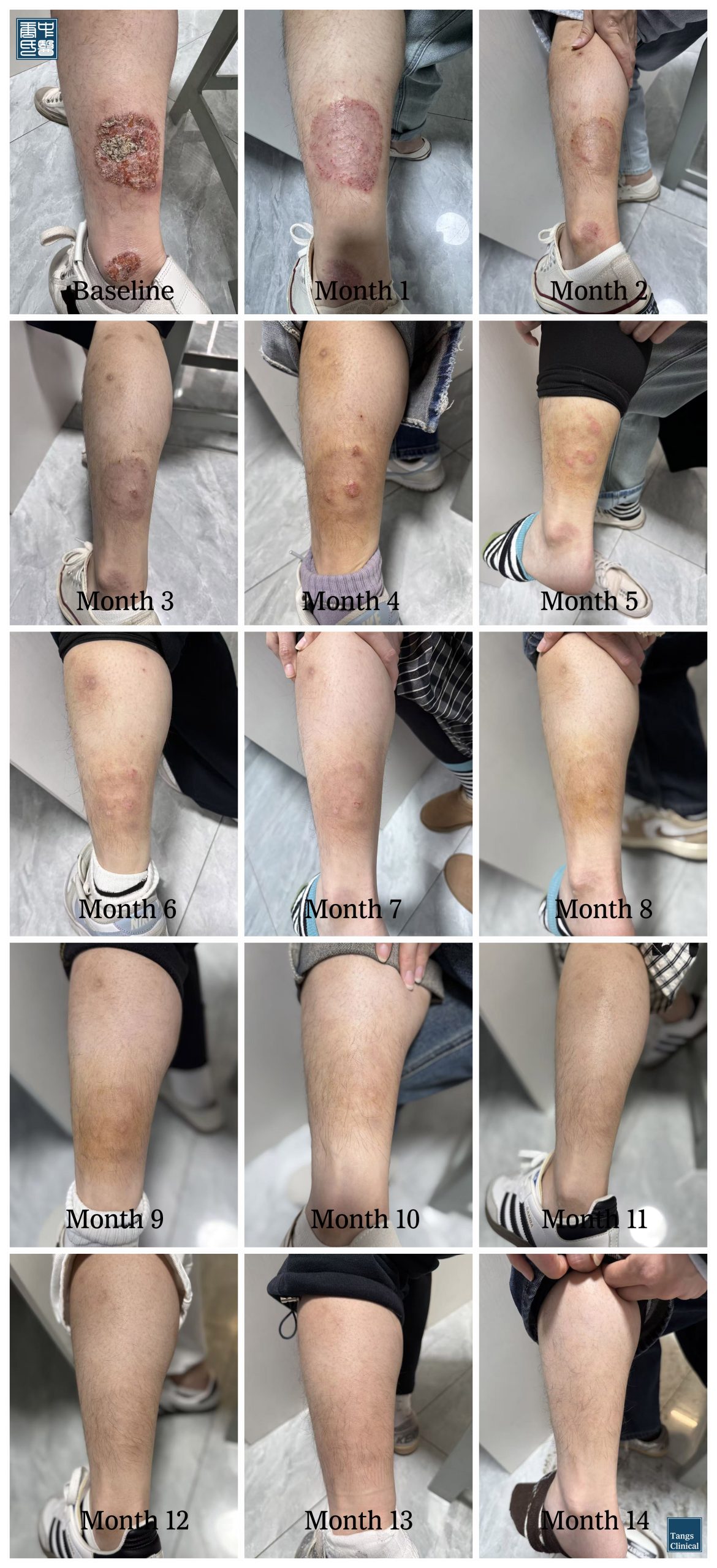
Figure 1. Serial photographs of the lower-leg lesion from baseline to month 14. Baseline images show a crusted, erythematous, lichenified plaque. Over follow-up, crusting and erythema progressively diminish, plaque thickness decreases, and residual post-inflammatory pigmentation becomes the dominant visible feature.
下肢皮损从基线至第14个月的连续照片。治疗前基线可见结痂、红斑及明显苔藓样增厚;随访中结痂与红斑逐步减轻,斑块厚度下降,后期以残余炎症后色素沉着渐渐消退为主。
二、基线皮损的中医与临床解读
从治疗前照片看,小腿皮损呈现出典型的慢性炎症性改变:明显结痂与皮表破损,红斑与色暗并存,皮肤增厚、粗糙、呈皮革样质地,苔藓样改变明显。从中医角度看,这类表现往往提示:湿热郁久,毒邪未清,兼夹血燥血瘀。也就是说,这已经不是单纯的急性发作,而是一块经过长期炎症、反复搔抓与修复失败后形成的“病理化皮肤地形”。
三、14个月恢复图谱:中医三阶段重塑模型
第一阶段:祛邪解郁,清热利湿(基线至第3个月)
在停止既往压制性治疗后的早期阶段,皮损仍然处于较活跃状态,可见结痂、残余渗出与明显炎症。从中医角度,这一阶段可理解为邪气反弹、湿热未清,病势仍留于肌表,不宜单纯压制,而应因势利导。此阶段的治疗重点在于:清热利湿,扶正气,祛邪毒。
前3个月的皮损从较明显的渗出结痂,逐步转向较干燥、边界更明确的慢性斑块状态。这可以理解为:病势由较急、较表的活动性炎症,过渡到较可控但尚未完全解决的慢性阶段。
第二阶段:调和营卫,缓解慢性炎症不稳定性(第4个月至第8个月)
随着急性炎症活动逐步减弱,治疗重点也随之转移。此时不再只是继续清解,而是要处理维持皮肤反复反应的内在失衡。从中医角度看,这一阶段重在 调和营卫、通络化滞、降低残余炎症倾向。红斑范围和浓度明显下降,皮损边界更清楚,斑块逐步变平,表面破损减少。这一阶段临床意义很大,因为它提示皮肤不再停留在持续高反应状态,而开始进入一个更稳定的修复轨道。
第三阶段:养血润燥,化瘀生新,支持结构修复(第9个月至第14个月)
最后阶段的重点,不再是急性炎症,而是长期病程遗留下来的后果:干燥、增厚、质地异常、色素残留以及局部组织修复不足。这一阶段的中医治疗原则包括:养血滋阴,润燥,活血化瘀,生肌修复。皮损逐步变平、变软,外观与周围正常皮肤更接近。虽然仍有一定色素残留,但活动性炎症特征已明显减弱。
其中一个值得注意的现象,是原本肥厚区域重新可见汗毛。从中医解释角度,这可理解为“皮毛得养、气血得达”的表现,与“肺主皮毛”的经典理论相呼应。若用现代临床语言,则可表述为:局部皮肤环境较治疗前明显改善,毛发表现亦较前更为可见。
四、本案例提示了什么
这个案例提示我们:慢性湿疹的恢复,未必只是“越快把红压下去越好”。对于部分病程长、反复发作的患者而言,真正的改善可能是一个分阶段展开的过程,包括:
活动性炎症逐步下降,慢性刺激与搔抓回路被打断,苔藓样增厚逐步软化,皮肤屏障质量和质地逐渐恢复,色素残留缓慢淡化。从中医临床视角看,这正是阶段性重塑,而不仅是事件性压制。
五、为什么选择 Tangs Clinical TCM
在 Tangs Clinical TCM,我们关注的,不只是把皮疹表面的红、痒、破损暂时压下去,而是去判断反复发作背后的病机模式,以及皮肤长期脆弱状态形成的原因。
- 辨证施治:根据不同时期的皮损表现与体质反应,动态调整方药
- 系统调节:不只看局部皮肤,而是重视与反复发作相关的整体失衡状态
- 长期恢复思维:目标不是追求短暂表面清除,而是帮助皮肤逐步进入更稳定、更可持续的缓解轨道
我们并不把慢性湿疹看成一块单纯需要“压住”的红斑,而是看成一个需要时机、层次与个体化调理的动态病程。
结语
慢性湿疹的康复,很少是一场短跑。更多时候,它是一段被炎症反复冲击、被搔抓不断破坏、又被时间慢慢修复的重整过程。在这个案例中,14个月的个体化中药治疗,伴随着炎症、厚度、质地与整体稳定性的逐步改善。对于那些长期困在“暂时控制—再次反复”循环中的患者,这个案例提供了一种不同的康复理解:真正的恢复,不一定是症状瞬间消失,而可能是皮肤一步步重新找回平衡与韧性。
Introduction
Many patients with chronic eczema or atopic dermatitis become trapped in a familiar cycle: symptoms improve during treatment, only to flare again when treatment is reduced or stopped. This repeated pattern often leaves patients not only physically exhausted, but also uncertain about whether their skin is truly recovering or merely being temporarily controlled.
This case presents a patient with a 2-year history of chronic eczema-like dermatitis who, after discontinuing prior immunosuppressive treatment, underwent a 14-month course of individualized Chinese herbal management at Tangs Clinical TCM. Over time, the lesion evolved from crusted, inflamed, thickened skin into a largely flattened area with residual pigmentation and visibly improved surface texture.
What makes this case meaningful is not the promise of a quick cure, but the visible trajectory of staged recovery: inflammation gradually subsiding, chronic thickening softening, and damaged skin moving toward structural repair.
A TCM View of Chronic Eczema: Why Symptom Suppression Alone May Be Insufficient
From a conventional perspective, steroids and other anti-inflammatory or immunosuppressive agents are often used to control active eczema flares. These approaches can be highly effective for symptom control in many patients. However, in some chronic relapsing cases, visible suppression of inflammation does not always translate into deeper or more durable restoration of skin stability.
From a TCM perspective, long-standing eczema is often not understood as a purely superficial skin problem. Rather, it may reflect a complex internal pattern involving dampness, heat, toxin accumulation, disharmony of ying and wei, blood dryness, and collateral stasis. When the disease becomes prolonged and recurrent, the skin may no longer present only with redness and itching, but with thickening, rough texture, pigmentation, and lichenified change.
In this framework, treatment is not limited to “making the rash disappear.” The goal is to address the evolving internal pattern behind recurrent inflammation and impaired repair.
Clinical Interpretation of the Baseline Lesion
At baseline, the lower leg lesion showed features consistent with chronic inflammatory eczema-like change:
- crusting and surface breakdown
- marked erythema and post-inflammatory darkening
- thickened, rough, leathery texture
- long-standing lichenified appearance
From a TCM standpoint, such morphology may be interpreted as a combination of damp-heat lingering in the skin, prolonged toxin constraint, and chronic blood stasis with dryness. In other words, this is no longer simply an acute flare, but a skin terrain that has undergone chronic pathological remodeling.
The 14-Month Recovery Timeline: A Three-Stage TCM Reconstruction Model
Stage 1: Releasing the Pathogenic Burden (Baseline to Month 3)
In the early phase after cessation of prior suppressive treatment, the skin remained active, with crusting, exudative residue, and visible inflammation. From a TCM perspective, this stage can be understood as one in which unresolved pathogenic factors are still present near the exterior and must be addressed rather than merely silenced. The treatment principle during this phase emphasizes:
- clearing heat
- draining dampness
- cooling blood
- relieving toxin accumulation
Clinically, the first few months showed a transition from more exudative and crusted lesions toward drier, more defined plaques. This may be interpreted as the disease process moving from a more acute, active inflammatory state into a more controlled but still unresolved chronic phase.
Stage 2: Harmonizing Ying and Wei, Reducing Chronic Inflammatory Instability (Month 4 to Month 8)
As acute inflammatory activity began to settle, the treatment focus shifted. At this stage, the main task was no longer simply to clear excess, but to regulate the internal imbalance sustaining repeated skin reactivity.
From a TCM perspective, this corresponds to harmonizing ying and wei, improving circulation through the collaterals, and reducing the residual inflammatory tendency embedded in the skin. During this phase, the recovery progress show:
- reduction in the area and intensity of erythema
- clearer lesion borders
- gradual flattening of the plaque
- less active surface disruption
This stage is particularly important clinically, because it suggests that the skin is no longer trapped in continuous high-grade inflammatory reactivity. Instead, it begins to move toward a more stable healing pattern.
Stage 3: Nourishing Blood, Softening Chronic Thickening, and Supporting Structural Repair (Month 9 to Month 14)
The final stage focused less on acute inflammation and more on the long-term consequences of chronic disease: dryness, thickening, altered texture, pigmentation, and incomplete tissue recovery. The TCM treatment principle in this period emphasizes:
- nourishing blood and yin
- moistening dryness
- invigorating blood
- dispelling stasis
- promoting regeneration of damaged skin terrain
Over the final months, the lesion became flatter, softer, and visually closer to surrounding skin. Residual pigmentation remained, but the active inflammatory character had largely subsided.
One notable observation was the reappearance of visible hair over previously thickened skin. From a TCM interpretive perspective, this may suggest improved local nourishment of the skin and appendages, consistent with the classical idea that “the lung governs skin and hair.” Clinically, it can be described more cautiously as a sign that the local skin environment appears more favorable than at baseline.
What This Case Suggests
This case illustrates an important clinical point: meaningful recovery in chronic eczema may require more than rapid suppression of visible inflammation. For certain patients, especially those with long disease duration and repeated relapse, improvement may unfold as a staged process involving:
- reduction of inflammatory activity
- interruption of chronic irritation and scratching cycles
- softening of lichenified skin
- gradual restoration of barrier quality and skin texture
- slow resolution of residual pigmentation
From a TCM clinical perspective, this is the logic of staged reconstruction rather than episodic suppression.
Why Tangs Clinical TCM
At Tangs Clinical TCM, the goal is not only to calm the visible rash, but to assess the deeper pattern behind recurrence and chronic skin fragility.
Our clinical approach emphasizes:
Syndrome differentiation: formulas are adjusted according to the patient’s evolving stage and presentation
Systemic regulation: treatment aims to improve the internal terrain associated with repeated flare patterns
Longitudinal recovery: the focus is on helping the skin move toward a more stable and sustainable state, rather than chasing temporary surface clearance alone
We do not view chronic eczema simply as a red patch that needs to be silenced. We view it as a dynamic disorder requiring timing, staging, and individualized correction.
Conclusion
Recovery from chronic eczema is rarely a sprint. It is more often a slow reorganization of inflamed, damaged, repeatedly stressed skin over time. In this case, 14 months of individualized TCM treatment coincided with visible improvement in inflammation, thickness, texture, and overall lesion stability.
For patients who feel trapped in cycles of temporary control and repeated relapse, this case offers another way to think about healing: not as a sudden disappearance of symptoms, but as a gradual return toward cutaneous balance and structural resilience.