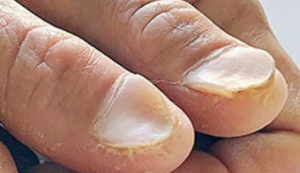
Real-World Relapse Rate After Biologic Withdrawal in Atopic Dermatitis 真实世界中生物制剂停药后特应性皮炎复发率
Real-world evidence underscores important differences in relapse dynamics after withdrawal of biologic therapy in atopic dermatitis. In a retrospective cohort (Wu et al.), 34.6% of dupilumab responders relapsed within 72 weeks, with a median time to relapse of 457 days, compared with 52.9% and a median of 60 days for JAK1 inhibitors (upadacitinib/abrocitinib) [1]. These data suggest that dupilumab affords more durable off-therapy control than JAK1 inhibitors.
However, broader registry analyses and heterogeneous real-world cohorts indicate a more sobering picture: only about ≈ 1 in 4 dupilumab patients remain flare-free at one year, while JAK1 inhibitor patients almost universally relapse within weeks. Median drug-free remission clusters around 8–10 months for dupilumab and less than one month for upadacitinib when treatment is stopped abruptly. Small “deep-remission” case series suggest that carefully selected patients may achieve ~9 months of remission, but such data are vulnerable to selection bias and remain unrepresentative [2-4].
Taken together, these findings highlight two consistent themes: (i) dupilumab confers the most durable remission among currently available biologics, and (ii) long-term drug-free disease control is rare, even with dupilumab. Until predictive biomarkers for sustained remission are established, permanent maintenance or structured dose-spacing strategies appear safer than full cessation.
Dupilumab provides the best odds (≈ 25 % one-year remission), whereas JAK1 inhibitors relapse within weeks. Until predictive biomarkers emerge, permanent maintenance or dose-spacing strategies trump full cessation.
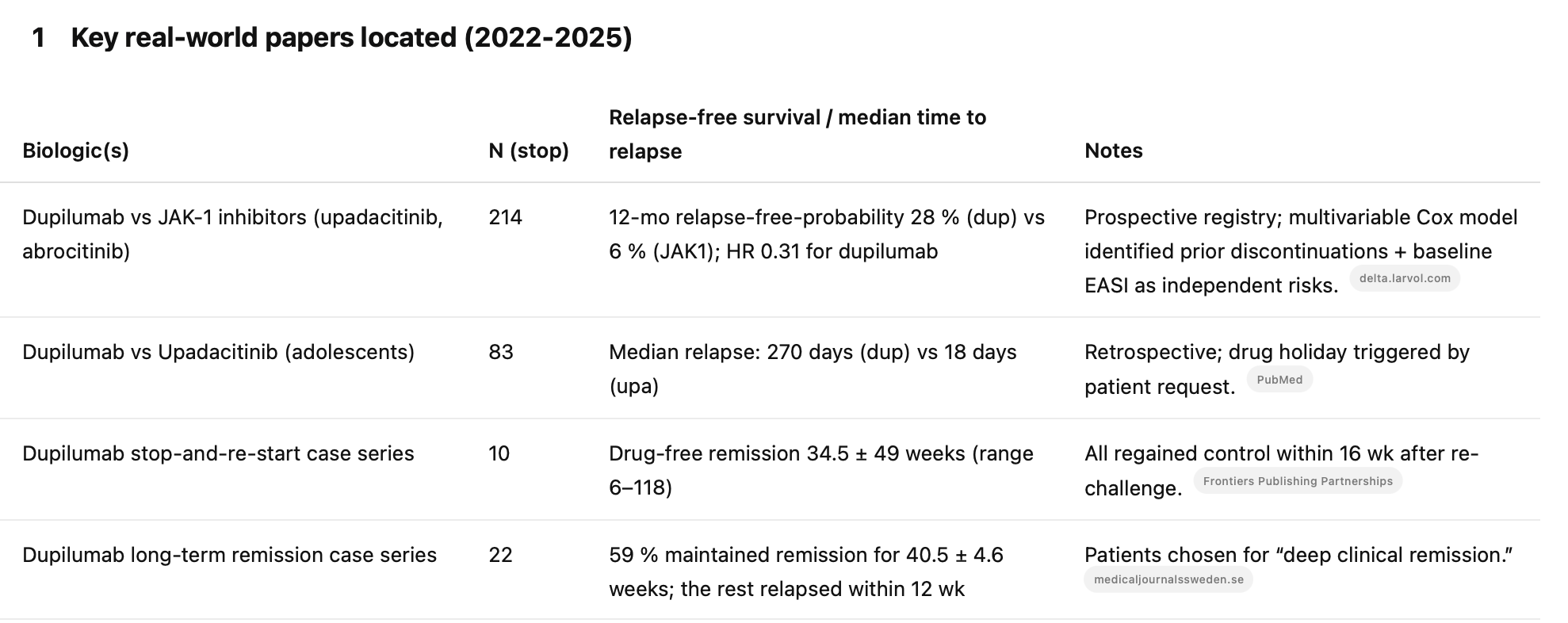
真实世界的证据揭示了特应性皮炎患者在停用生物制剂后复发动态上的显著差异。Wu 等人的回顾性队列研究显示,34.6% 的 dupilumab 应答者在停药 72 周内复发,中位复发时间为 457 天;而 JAK1 抑制剂(upadacitinib/abrocitinib)患者的复发率为 52.9%,中位复发时间仅 60 天 [1]。这些数据提示 dupilumab 在停药后的控病持久性优于 JAK1 抑制剂。
然而,更大规模的注册研究和异质性真实世界队列呈现了更为谨慎的结果:仅约四分之一的 dupilumab 患者在停药一年后仍无复发,而 JAK1 抑制剂患者几乎普遍在数周内复发。停药后,dupilumab 的中位无病期集中在 8–10 个月,而 upadacitinib 通常不足 1 个月。少数“深度缓解”病例系列显示,经严格筛选的患者可能获得约 9 个月的缓解,但其代表性不足且存在选择偏倚[2-4]。
综上所述,结果一致指出两个关键点:(i) dupilumab 在现有生物制剂中停药后的缓解时间最长;(ii) 即便如此,长期无药缓解仍属罕见。直到能够找到可靠的持续缓解预测生物标志物之前,维持治疗或有计划的减量/间隔方案较全面停药更为安全。
Dupilumab (Dupixent) 的一年无病率约 25 %,JAK1 抑制剂数周即复发。在缺乏可预测生物标志物前,维持治疗或延长给药间隔优于完全停药。
Reference
- Wu H, Zhu J, Yang N, Ji X, Li Z, Zhou Y, Xu Q, Ye Y, Bai Z, Wang J, Li Z. Atopic dermatitis relapse after treatment discontinuation and predictive factors for relapse: JAK1 inhibitors versus dupilumab. J Dtsch Dermatol Ges (Journal of the German Society of Dermatology). 2025 May 2. doi: 10.1111/ddg.15688. Epub ahead of print. PMID: 40317605.
- Zhu J, Wu H, Ye Y, Xu Q, Shao J, Bai Z, Zhou Y, Li Z, Liu J, Li Z. Efficacy, Safety, and Early Relapse After Cessation of Upadacitinib Versus Dupilumab in Adolescents with Moderate-to-Severe Atopic Dermatitis®: A Real-World Study in China. Dermatitis. 2024 Nov-Dec;35(6):636-645. doi: 10.1089/derm.2024.0014. Epub 2024 Aug 20. PMID: 39163276.
- Matsutani M, Imai Y, Miyamoto S, Inoue Y, Natsuaki M and Kanazawa N (2024) Real-world efficacy of dupilumab re-administration after discontinuation in patients with atopic dermatitis. J. Cutan. Immunol. Allergy7:12480. doi: 10.3389/jcia.2024.12480
- Miyamoto, S., Imai, Y., Natsuaki, M. ., Yamanishi, K. ., & Kanazawa, N. (2022). Long-term Remission of Atopic Dermatitis after Discontinuation of Dupilumab. Acta Dermato-Venereologica, 102, adv00731. https://doi.org/10.2340/actadv.v102.295